Petrol vs CNG vs EV: Which Car Is Better for Delhi City Driving?
It’s 8:45 am and you’re already late. The traffic ahead isn’t moving. You glance at the clock, then at the fuel gauge, and a thought creeps in: why am I spending so much on fuel every month?
If that sounds familiar, you’ve probably wondered about the Petrol vs CNG vs EV question too. Which one would actually make your daily life easier, and which is the best car for Delhi city driving?
Here’s the honest answer: the cheapest car to run isn’t automatically the best car for you. A petrol car might be a poor fit for one driver and perfect for another. A CNG car can save you money every month but turns into a chore if you’re always hunting for a station. An electric car can be brilliant for your office commute, until you suddenly plan a 400 km road trip.
So let’s skip the marketing talk and look at petrol vs CNG vs EV the way a real Delhi car buyer would.
Start With Your Daily Drive.
Before you compare fuel prices, answer five questions:
How many kilometres do you drive every day?
Do you mostly stay inside Delhi, or travel across NCR?
Do you take highway trips regularly?
Do you have dedicated parking at home?
Can you install a charger where you park?
Your answers may decide the winner before you even look at a single car. There is no universal answer to petrol vs CNG vs EV. The right choice depends on how you gone drive.
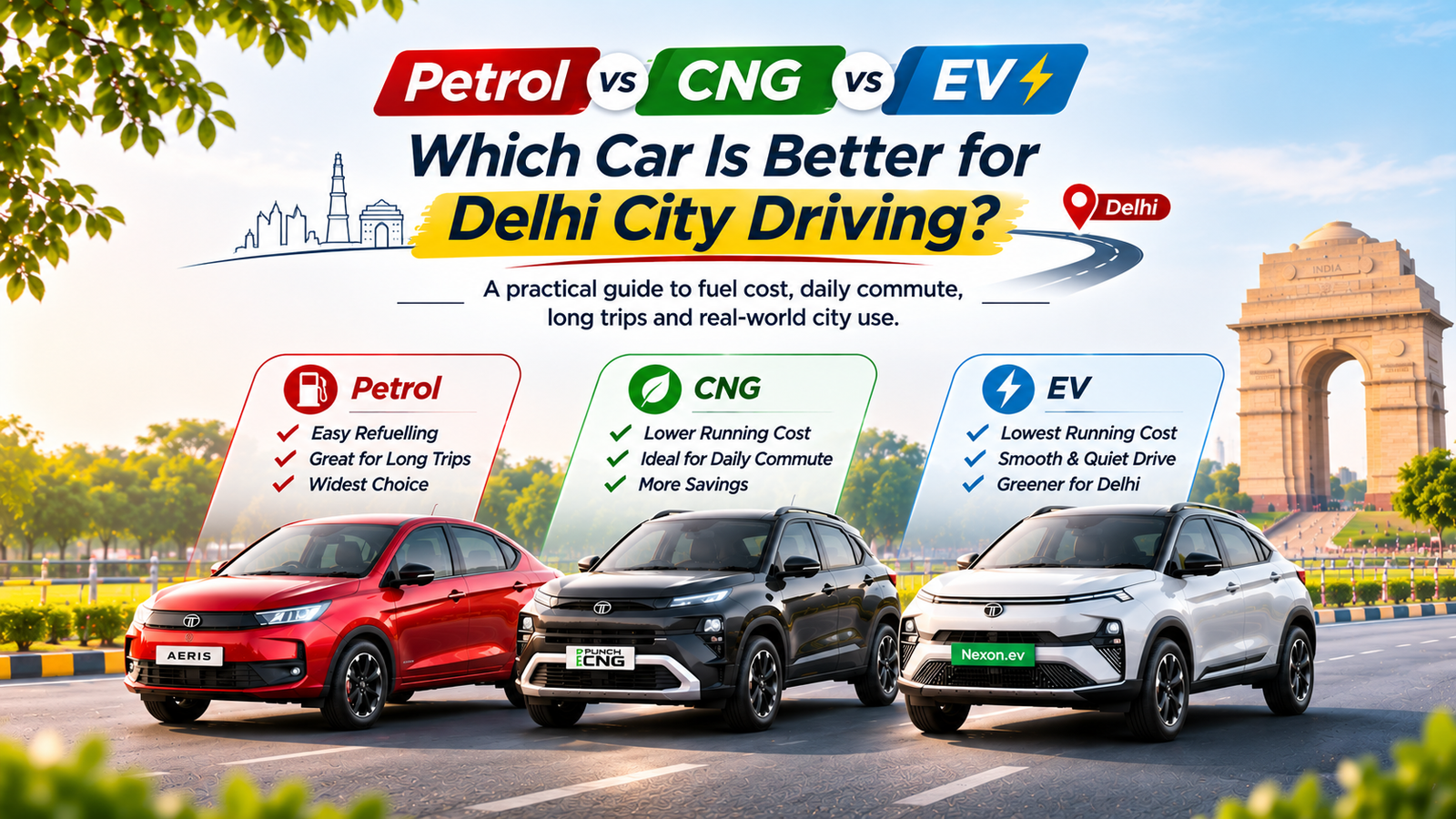
Petrol vs CNG vs EV at a Glance
Here’s the quick version before we get into detail.
What matters to you | Petrol | CNG | EV |
Easy refuelling | Excellent | Good | Needs planning |
City driving comfort | Good | Good | Excellent |
Low running cost | Average | Good | Excellent |
Long trips | Excellent | Good | Average |
No need to plan charging | Excellent | Excellent | Poor |
High daily running | Average | Excellent | Excellent |
Smooth, quiet driving | Good | Average | Excellent |
These ratings are general guidance, not a verdict. The best car for Delhi city driving changes with how you use it, which is what the rest of this guide is about.
Petrol Cars: The “I Don’t Want to Think About It” Choice
Start with the familiar one.
You don’t need to check where the next pump is. You don’t need to plan tomorrow’s commute around a charger. And if someone says, “Let’s drive to Jaipur this weekend,” you just fill up and go. That freedom is the biggest advantage of a petrol car.
Why a petrol car in Delhi still works well
Petrol pumps are everywhere, and options exist in almost every category, from compact hatchbacks to sedans and SUVs. There’s a car for nearly every budget.
A petrol car makes the most sense if you:
- Don’t drive every day
- Have relatively low monthly running
- Travel outside Delhi often
- Like spontaneous road trips
- Can’t set up home charging
The downside
Traffic. If you crawl through Delhi for hours every week, the fuel bill adds up fast. That’s usually when the CNG vs petrol question comes up.
CNG Cars: The “I Drive a Lot” Choice
Picture a normal week. Home to office, then a client meeting, then back home, then another 20 to 30 km of errands. Add a weekend trip and you’ve covered hundreds of kilometres before Monday.
This is where a CNG car in Delhi starts to make sense. In the petrol vs CNG vs EV race, CNG is the value player: lower running cost. When you drive a lot, even a small saving per kilometre becomes significant over a few months. That’s why CNG stays popular with high-mileage drivers, daily commuters and commercial users.
The catch
Ask any regular CNG user what they dislike most. Many will say the queue. At busy stations, waiting becomes part of the routine. Depending on the car, the CNG cylinder can also take away boot space.
So the CNG vs petrol decision isn’t simply “cheap fuel, best choice”. It’s a trade-off. You save on running costs, but you need to be comfortable with the refuelling routine.
CNG suits you if you drive a lot, have convenient stations on your regular routes, and want to keep monthly costs under control.
“For buyers comparing petrol and CNG options, the Tata Nexon is worth exploring for its available fuel choices.”
Electric Cars: What If You Never Visited a Fuel Station?
Imagine reaching home at 8 pm, parking, plugging in and going upstairs for dinner. In the morning you unplug and leave. No pump, no queue, no separate refuelling trip.
That’s the biggest attraction of an electric car in Delhi if you have home charging. Refuelling stops being an errand and becomes something that happens while you sleep.
In petrol vs CNG vs EV, the EV scores highest on comfort. Delhi’s stop-start traffic is where it feels at its best. Power arrives smoothly and instantly, and you don’t get the engine noise and vibration of constant clutch-and-brake driving.
The question every EV buyer asks
“What if I run out of charge?”
If you mostly drive from home to office and back, an EV can be extremely convenient. If you often decide at the last minute to drive hundreds of kilometres, you’ll need to think about charging stops and charging time. An EV isn’t inconvenient. It just needs a different kind of planning.
Petrol vs CNG vs EV Running Cost: How to Work Out the Real Numbers
Most comparisons make this part complicated, so here’s the simple version. Your running cost depends on three things:
How much you drive × how efficiently your car uses energy × what that energy costs.
You can work out your own cost per kilometre in a minute:
Petrol or CNG: fuel price per litre or kg ÷ kilometres per litre or kg
EV: electricity tariff per unit × units used per kilometre
Plug in this month’s rates and your own driving figures, and you’ll see where you stand. When you compare CNG vs petrol, the gap grows with every extra kilometre you drive. Someone driving 10 km a day and someone driving 70 km a day shouldn’t make the same decision.
Don’t forget the upfront price. EVs and CNG variants usually cost more than the equivalent petrol car, so ask how many months of fuel savings it takes to recover the difference. If you plan to keep the car for several years, the answer may favour CNG or EV. If you’ll sell in two years, it might not.
Which Car Suits Which Driver?
Here’s how petrol vs CNG vs EV plays out for three very different drivers.
Driver A: The Weekend Driver
You work from home and use the car for groceries, family outings, restaurants and the occasional trip. Paying more upfront just to save on running costs may not make financial sense for you.
Best fit: petrol. You get flexibility without worrying about charging or CNG availability.
Driver B: The Daily Delhi Commuter
You travel every day, say Delhi to Gurugram, Noida to Delhi, or Dwarka to Central Delhi, five or six days a week. Your monthly kilometres are high, so running cost matters a lot.
Best fit: CNG or EV. A CNG car in Delhi is very attractive on cost. If you have reliable home charging, an electric car in Delhi is a strong contender too. Compare the purchase price, running cost, refuelling convenience and how long you plan to keep the car.
Driver C: The Road-Trip Person
You love getting out of Delhi: Jaipur, Agra, Chandigarh, Rishikesh. You might decide on a Friday evening to go somewhere this weekend, and you don’t want the trip to revolve around the next charging stop.
Best fit: petrol. CNG can work if your routes have good station coverage. EVs can handle road trips too, but they need more careful planning.
What Delhi Traffic Changes
If you spend a lot of time in stop-and-go traffic, an EV’s smooth power delivery makes the drive noticeably more relaxed. A CNG car keeps your running expenses down. A petrol car gives you the flexibility you’re used to.
So think about what annoys you most:
- High fuel bills? Look at CNG or EV.
- Charging planning? Petrol or CNG may suit you better.
- CNG queues? An EV may be worth considering.
- Long-distance uncertainty? Petrol is hard to beat.
Petrol vs CNG vs EV: What About Maintenance?
EVs have an advantage here, but it’s easy to exaggerate. An electric car has no conventional engine, so there are fewer engine-related maintenance needs. But it isn’t maintenance-free. You still have tyres, brakes, suspension, air conditioning, electronics and battery systems to look after.
A petrol car needs regular engine maintenance. A CNG car has the same kind of engine, plus the components of the CNG system.
So skip the question “which car has zero maintenance?” because none does. Ask instead: which maintenance routine am I more comfortable with?
Parking Can Decide Your Petrol vs CNG vs EV Choice
This sounds boring, but it can decide whether an EV is right for you. Ask yourself where your car sleeps every night.
An electric car in Delhi becomes far more convenient if you have:
- Dedicated parking
- A suitable electrical connection
- Permission to install a charger
If you park on the street, or somewhere you can’t install a charger, EV ownership can feel very different. That’s why home charging access should be one of the first questions you ask, not the last.
Petrol vs CNG vs EV: Which One Should a Delhi Buyer Choose?
Here’s the shortest way to find the best car for Delhi city driving for your own routine.
Choose petrol if you want flexibility, take frequent road trips, have low monthly running and don’t want to think about charging. Petrol means freedom.
Choose CNG if you drive a lot, your regular routes have convenient stations, and running cost is a priority. You should also be fine with an occasional wait at the pump. CNG means practical savings.
Choose an EV if you mostly drive in the city, have home or workplace charging, want smooth and quiet driving, and plan to keep the car for several years. EV means smart city mobility.
The simplest verdict:
Low running + frequent road trips → Petrol
High running + easy CNG access → CNG
Daily city driving + home charging → EV
The Final Answer Isn’t Petrol, CNG or EV. It’s You.
The petrol vs CNG vs EV decision has no magic answer that’s perfect for every Delhi driver. Petrol can be the smartest choice for one person. CNG can save another thousands over time. An EV can completely change the daily drive for someone else.
So before you book your next car, look at your last 30 days:
- How many kilometres did you drive?
- How much did you spend on fuel?
- How often did you travel outside Delhi?
- Where do you park?
- Could you charge an EV overnight?
- Are there convenient CNG stations on your daily route?
Your answers will tell you more than any generic “best fuel” list. And if you’re still unsure, don’t choose based on what’s trending. Take a test drive. The car that looks best on paper isn’t always the one that feels best on your everyday Delhi drive.
Still Comparing Petrol vs CNG vs EV? Talk to Frontier Group
The best way to settle petrol vs CNG vs EV is to see the cars for yourself. Visit Frontier Group, compare your options side by side and take a test drive on the kind of roads you actually use. Our team can help you match the car to your daily routine, so you buy the one that fits your life, not just your budget.